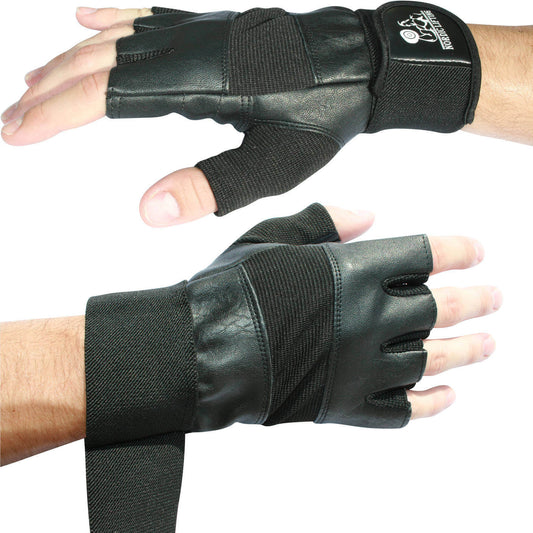
Most lifters need one good pair of lasso straps, and choosing them comes down to type, material, length and padding. This guide shows which strap type fits which lift, what to check before you buy, and what studies say about straps and deadlift strength.

Quick answer: Choose lifting straps by the lift first. A padded lasso strap suits most lifters because it sets fast and lets go fast on deadlifts, rows and pull-ups. Figure 8 straps are for heavy holds you will never drop, closed loops suit Olympic pulls, and hooks trade bar contact for speed. Then check material, length, width and stitching.
Key takeaways
- Start with a lasso strap unless you have a clear reason to pick another type.
- Match the strap to the lift. Skip figure 8 straps on any lift you may need to bail out of, and never use straps for pressing.
- Studies link straps with a higher deadlift max, but no study has yet shown long-term training effects.
The Nordic Lifting Take
Your first pair of lifting straps should be a padded lasso. I design every Nordic Lifting product myself, and with straps I look at two things before anything else: can you get out of them with one turn of the hand, and will the stitching at the loop hold up. Get those two right and the color is up to you.
Henrik Andersson, founder of Nordic Lifting
By the numbers
- In a 2022 study of 18 resistance-trained men, deadlift one-rep max averaged 162.0 kg without lifting straps and 179.0 kg with them (Jukic et al., 2022).
- A 2022 study of 16 resistance-trained men found no significant differences in bar velocity or power between deadlifts with and without straps at 20, 40, 60 and 80% of their no-strap one-rep max (Jukic et al., 2022).
- A 2026 review concluded that straps can raise maximal strength and grip perception, and that no scientific evidence yet supports long-term training effects from using them (Martins et al., 2026).
- USPA permits a strap in the deadlift only for a lifter missing at least 50% of their total fingers, including the thumb, on the gripping hand, attached at the wrist only (USPA Technical Rules 2025, Item 6.3.20).
Journalists and writers may use these figures if they credit the original sources linked above.
What are the main types of lifting straps?
There are four common types: lasso straps, figure 8 straps, closed loop straps and lifting hooks. They differ in how they hold the bar and how fast you can let go, which matters more than brand or color when you choose.
| Type | How it holds the bar | Release | Usually best for |
|---|---|---|---|
| Lasso | Loop on the wrist, tail wrapped around the bar and twisted tight | Fast: open your hand and unwind | Deadlifts, rows, pull-ups, shrugs |
| Figure 8 | One loop around the wrist, one around the bar | Slow: the bar stays locked to your hand | Heavy shrugs, rack pulls, holds you set down |
| Closed loop | Short sewn loop that wraps the bar about once | Fast | Snatch and clean pulls |
| Hooks | Wrist cuff with a metal hook that cups the bar | Fast | Quick setup on high-rep pulling |
A lasso strap is the most flexible of the four. It works on nearly every pulling lift and you can loosen it between sets in a second. Figure 8 straps hold tighter, but that is also the catch: you can't drop the bar quickly. Hooks are fast, though your fingers do less of the gripping.
Which lifting strap type is best for each lift?
For deadlifts, Romanian deadlifts, rows and pull-ups, a lasso strap is the usual pick. For heavy shrugs and rack pulls you will set down, a figure 8 also works. For snatch and clean pulls, use a closed loop or a lasso you can release. For pressing, skip straps and use wrist wraps.
| Lift | Strap type that usually fits |
|---|---|
| Deadlifts and Romanian deadlifts | Lasso. Quick to set between sets and easy to loosen. |
| Rows, pull-ups and lat work | Lasso. Short sets, frequent changes, fast release. |
| Heavy shrugs and rack pulls | Lasso or figure 8, if you will set the bar down, never drop it. |
| Snatch and clean pulls | Closed loop or lasso. You must be able to let go of the bar. |
| Bench and overhead press | No straps. Use wrist wraps on pressing days. |
Strap chooser: pick the lift you want straps for.
Pressing is the one place lifters mix the two up. Straps are for pulling. If your wrists bend back on the bench or overhead press, that is a job for wrist wraps, and our 14 vs 24 vs 30 inch wrist wraps guide covers the lengths.
What material should lifting straps be made of?
Most lifting straps are made of cotton, nylon or leather. The name of the material only tells you part of the story, since weave, thickness and stitching vary from one maker to the next. Read the product details and look at close-up photos of the strap and the seams before you buy.
Ours are heavy-duty cotton, which grips the bar well and twists tight around it, with neoprene padding at the wrist for comfort on long sessions. Some lifters remove the padding for a closer fit on the bar.
How long and wide should lifting straps be?
A strap should be long enough to loop your wrist and wrap the bar about once and a half, while you can still close your hand around it. If it wraps more than that, choke up on the loop. Width should cover the bar under your fingers without bunching in your palm.
Our straps are 1.5 x 23 inches, which is long enough to loop the wrist and wrap the bar about once and a half for most hand sizes. In this review, a lifter measures a pair and shows the stitching up close.
MotivatedResults measures our cotton lifting straps and looks at the stitching. Video: MotivatedResults.
What else should you check before you buy lifting straps?
Check the padding and the stitching. A padded wrist loop is more comfortable on long pulling sessions, and the seam where the loop is sewn is the part that takes the load, so it should be neat, even and reinforced. Then check you are buying the right count: some packs hold one pair, ours hold two.
| Point | Detail |
|---|---|
| Type | Lasso for most lifters. Figure 8 or closed loop only for the lifts they suit. |
| Material | Read what the maker says it is made of, and how it should feel on the bar. |
| Length | Long enough to loop the wrist and wrap the bar, short enough to still close your hand. |
| Width | Wide enough to cover the bar under your fingers without bunching in the palm. |
| Padding | A padded wrist loop is more comfortable on long pulling sessions. |
| Stitching | Look at the seams where the loop is sewn. That is where straps take the load. |
What does research say about lifting straps?
Straps let you hold more weight in the moment. In lab studies, trained men lifted a heavier deadlift max with straps than without, but straps made no difference to bar speed or power at lighter loads, and no study has yet shown what they do over months of training. Use them on your heaviest sets and keep some pulls strap-free for your grip. Our how to use lifting straps guide walks through the wrap step by step.
| Point | Detail |
|---|---|
| 162.0 vs 179.0 kg Average deadlift one-rep max without and with lifting straps in 18 resistance-trained men. Jukic et al., 2022 | |
| No difference In bar speed or power at 20, 40, 60 and 80% of the no-strap one-rep max, in 16 resistance-trained men. Jukic et al., 2022 | |
| Not yet shown A 2026 review found no scientific evidence so far for long-term training effects of using straps. Martins et al., 2026 |
Can you use lifting straps in a powerlifting meet?
Usually not. The USAPL raw kit list covers a singlet, T-shirt, undergarments, shoes, socks, belt, wrist wraps and knee sleeves, with no lifting straps (Rulebook v2026.2, Item 3.1.4). USPA allows a strap in the deadlift only for lifters missing at least half their fingers on the gripping hand. If you compete, practice your heavy pulls without straps too. For a wider look at hand position, see our beginner guide to weightlifting grips.

Nordic Lifting Lifting Straps, 2 Pairs
4.6 (150 reviews)
Padded lasso-style straps in heavy-duty cotton, 1.5 x 23 inches, with neoprene wrist padding.
$19.58
Padded lasso-style straps in heavy-duty cotton, 1.5 x 23 inches, with neoprene wrist padding. Two pairs per pack, in Aqua Blue and Camo Grey.Want wrist wraps for pressing days too? See everything in our straps and wraps collection.
Frequently asked questions
What type of lifting straps should a beginner buy?
A padded lasso strap. It is quick to put on, easy to release and works for deadlifts, rows, shrugs and pull-ups.
Are figure 8 straps better than lasso straps?
Figure 8 straps hold more securely but are slow to release, so they suit heavy shrugs, rack pulls and holds you set down. Lasso straps are the more flexible choice for most lifts.
How long should lifting straps be?
Long enough to loop your wrist and wrap the bar about once and a half while you can still close your hand. Ours are 1.5 x 23 inches.
Are lifting hooks better than straps?
Hooks are faster to set up, but your fingers do less of the gripping. Straps keep your hand wrapped around the bar. Choose hooks for speed and straps if you want a more natural grip.
Can you use lifting straps in a powerlifting meet?
Usually not. The USAPL raw gear list does not include straps, and USPA allows a strap in the deadlift only for lifters missing at least half their fingers on the gripping hand.
Sources
- Jukic et al., J Strength Cond Res 2022 (PubMed 32287093)
- Jukic et al., J Strength Cond Res 2022 (PubMed 32341244)
- Martins et al., Int J Sports Physiol Perform 2026 (PubMed 41569827)
- USPA Technical Rules, March 24, 2025, Item 6.3.20
- USA Powerlifting Rulebook v2026.2, Item 3.1.4