Updated November 23, 2026
How can kettlebell swings benefit you? The swing is one of the most popular kettlebell exercises because it trains your hips, legs, back and grip in one powerful movement and gets your heart rate up at the same time. Here are the key benefits, what the research shows, how to do the swing with good form and how long a kettlebell workout should be.
Quick answer: Kettlebell swings build hip and leg power, train the whole back of your body (glutes, hamstrings and back), challenge your grip and raise your heart rate, so you get strength and conditioning in one move. In one study, 6 weeks of twice-weekly swing sessions lasting 12 minutes was followed by gains in squat strength and jump height.
Key takeaways
- Swings work the posterior chain: glutes, hamstrings, back and grip.
- Short sessions work: 10 to 20 minutes of swings with rest is enough for most people.
- The movement is a hip hinge, not a squat, and the arms only guide the bell.
- Start light and build up the weight once your form is consistent.
The Nordic Lifting Take
The swing is the kettlebell move I would teach first, because it grooves the same hip hinge you need for deadlifts and gets your heart rate up in the same set. Keep the sessions short and sharp: a few minutes of clean, powerful reps does more than half an hour of sloppy ones. If your lower back is doing the work instead of your hips, put the bell down and drill the hinge.
Henrik Andersson, founder of Nordic Lifting
By the numbers
- In a 2012 study of 21 men, 6 weeks of twice-weekly kettlebell swing training was followed by a 9.8% increase in half squat one-rep max across the training groups (Lake and Lauder, 2012).
- The same 2012 study reported a 19.8% increase in vertical jump height, from 20.6 cm to 24.3 cm, across both training groups; the swing group trained in 12-minute sessions of 30 seconds on and 30 seconds off (Lake and Lauder, 2012).
- The 2024 Adult Compendium of Physical Activities lists kettlebell swings at 9.8 METs, close to 10 times the energy you use at rest and above the 7.5 METs listed for vigorous kettlebell circuits (2024 Adult Compendium).
- In 2020, 31.0% of US adults met the federal guideline for muscle-strengthening activity on 2 or more days a week (CDC NCHS Data Brief 443).
More data: see our US strength training statistics page.
Journalists and writers may use these statistics if they credit Nordic Lifting with a backlink to this page. Questions: henrik@nordiclifting.com.

What are the benefits of kettlebell swings?
The main benefits of kettlebell swings are hip power, a stronger posterior chain and conditioning in a short session. Here are the ten we see most often.
1. It trains your whole body
One session of swings works your glutes, hamstrings and back, while your core, shoulders and lats keep the bell under control. It is one of the few single exercises that trains so many muscle groups at once.
2. It helps build and shape muscle
Because swings load the hips and back through a big range of motion, they help build muscle in the glutes and hamstrings, especially when you progress the weight over time.
3. It combines strength and cardio
Swings are a strength exercise that also raises your heart rate and breathing. Done in intervals, they double as interval training.
4. It burns energy fast
Swings use a lot of muscle, so they burn a lot of energy for the time spent. The 2024 Compendium of Physical Activities lists kettlebell swings at 9.8 METs, one of the higher values in its conditioning exercise table. Combined with sensible eating, that can support fat loss goals.
5. It supports heart and lung fitness
Fast swing intervals challenge your heart and lungs as well as your muscles, which is why many people use them as a short conditioning finisher.
| Drive the bell | Control the bell |
|---|---|
| Glutes | Core bracing |
| Hamstrings | Shoulders and lats |
| Back muscles | Grip |
| Hip power from the snap | Feet rooted to the floor |
6. It builds balance and core control
Every rep asks you to brace your core and stay rooted through your feet while the bell moves away from your body. That trains stability and control.
7. It strengthens your posterior chain
Your posterior chain is the group of muscles along the back of your body. A strong posterior chain helps with posture and with lifts like the deadlift.
8. It improves athletic power
The swing is an explosive hip extension, the same action used in jumping and sprinting. In the 2012 study above, vertical jump height rose by 19.8% after six weeks of training.
9. It improves hip mobility
Each rep takes your hips through a deep hinge and a full lockout, which helps you move well through the hips and hamstrings.
10. It is simple and convenient
You need one kettlebell and a small patch of floor. That makes swings easy to fit into a home workout, a warm-up or a busy lunch break.

How do you do a kettlebell swing with good form?
Hinge at the hips, hike the bell back between your legs, then snap your hips forward so the bell floats to chest height. Your arms guide the bell; your hips do the work.
- Stand with your feet a little wider than shoulder width, with the kettlebell about a foot in front of you.
- Hinge at the hips, keep your back flat and grab the handle with both hands.
- Hike the bell back between your legs like a football snap.
- Drive your hips forward and squeeze your glutes to stand tall. Let the bell float to about chest height.
- Let the bell fall back, hinge again as it passes between your legs and go straight into the next rep.
- Keep your core tight and do not lean back at the top.
| No. | Step | Detail |
|---|---|---|
| 1 | Set up | Feet a little wider than shoulder width, bell about a foot in front of you. |
| 2 | Hinge and grab | Hips back, flat back, both hands on the handle. |
| 3 | Hike | Hike the bell back between your legs like a football snap. |
| 4 | Snap | Drive your hips forward and squeeze your glutes to stand tall. |
| 5 | Float | Let the bell float to about chest height. Arms guide, hips work. |
| 6 | Repeat | Let it fall, hinge as it passes your legs, go straight into the next rep. No leaning back. |
What are common kettlebell swing mistakes?
| Mistake | Fix |
|---|---|
| Squatting the bell up | Push your hips back, keep shins fairly vertical and think hinge, not squat |
| Lifting with the arms | Let the hip snap move the bell; arms stay long and relaxed |
| Leaning back at the top | Finish tall with glutes squeezed and ribs down |
| Rounding the back | Keep a flat back and look a few feet ahead on the floor |
| Going too heavy too soon | Master 10 clean reps with a lighter bell first |
How long should a kettlebell workout be?
For most people, 10 to 20 minutes of swings, or a 20 to 30 minute full kettlebell workout, is enough. The 2012 study used 12-minute sessions twice a week: 12 rounds of 30 seconds of swings followed by 30 seconds of rest. Beginners can start with 6 to 8 rounds and add rounds as fitness improves.
Can kettlebell swings help with weight loss?
Swings can help because they burn a lot of energy in a short time and build muscle, but weight loss still depends on your overall activity and eating habits. Pair two or three swing sessions a week with regular walking and a balanced diet. Our kettlebell weight loss guide has sample workouts.
What does the latest research say about kettlebell training?
A 2024 review in Cureus summarized kettlebell training as a flexible way to build strength, power and endurance in athletes (Jaiswal et al., 2024). Most studies are small and short, so treat swings as one useful tool in a balanced program rather than a complete plan.
Ready for more? Try our kettlebell workouts for all levels and the lower body workout guide.
| Item | Value | Note |
|---|---|---|
| Study plan | 12 rounds: 30 s swings, 30 s rest |
12 minutes, twice a week for 6 weeks in the 2012 study. |
| Beginners | 6 to 8 rounds |
Add rounds as your fitness improves. |
| Most people | 10 to 20 minutes of swings |
Or a 20 to 30 minute full kettlebell workout. |
How do you build muscle with kettlebells?
Train your whole body two to four times a week around a few compound moves, add reps or weight slowly, and eat and sleep enough to recover. Kettlebells suit this because swings, squats, presses and carries each use several large muscle groups at once. Once a set feels easy, add a rep or a set, or move up to a heavier bell. Change one thing at a time so you can tell what works.
| Move | Main muscles | Starting point |
|---|---|---|
| Goblet squat | Quads, glutes, core | 3 sets of 8 to 10, bell held at your chest |
| Two-hand swing | Glutes, hamstrings, back, grip | 5 to 8 sets of 10, as in the swing guide above |
| Shoulder press | Shoulders, triceps, upper back | 3 sets of 6 to 8 per arm |
| Farmer carry | Grip, upper back, core | 3 walks of 20 to 30 seconds per hand |
| Turkish get-up | Shoulders, core, hips | 1 to 3 slow reps per side with a light bell |
What weight kettlebell should a beginner start with?
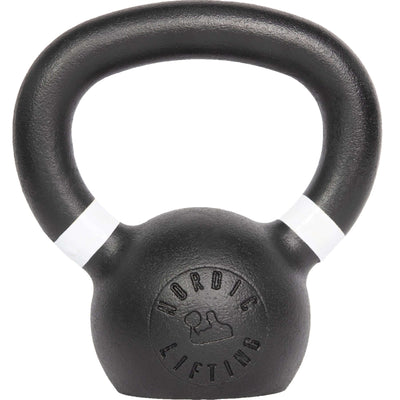
Many beginners start between 8 and 12 kg (18 to 26 lb) for squats and presses. Pick a weight you can lift for 10 reps with good form, and size up when that feels easy. The Nordic Lifting kettlebell comes in sizes from 9 lb up, so you can step up as you get stronger.
Frequently asked questions
What are the main benefits of kettlebell swings?
Kettlebell swings build hip and leg power, strengthen the glutes, hamstrings and back, train grip and raise your heart rate, so you get strength and conditioning in one exercise.
How long should a kettlebell workout be?
For most people 10 to 20 minutes of swings, or a 20 to 30 minute full kettlebell workout, is enough. One study used 12-minute sessions of 30 seconds on and 30 seconds off, twice a week.
How many kettlebell swings should I do a day?
Beginners can start with 5 to 8 sets of 10 swings with rest between sets, two or three times a week, and build up as form and fitness improve.
Are kettlebell swings good for weight loss?
They can help because they burn a lot of energy in a short time and build muscle, but weight loss also depends on your overall activity and diet.
What muscles do kettlebell swings work?
Mainly the glutes, hamstrings and back muscles, with the core, shoulders, lats and grip working to control the bell.
What weight kettlebell should I start with?
Many beginners start with a moderate bell they can swing for 10 clean reps, then move up once their hip hinge is consistent. The 2012 study used 12 kg for men under 70 kg and 16 kg for heavier men.
How often should I train with kettlebells to build muscle?
Two to four full-body sessions a week works for most beginners. Leave at least a day between hard sessions for the same muscles.
Which kettlebell exercises build the most muscle?
Compound moves such as goblet squats, swings, presses and carries, because each one trains several large muscle groups together.
Can kettlebells replace barbells and dumbbells for muscle growth?
For a beginner training at home they can, since you can load squats, presses and swings. Adding dumbbells or a barbell later makes smaller weight jumps easier.
Sources
- Lake and Lauder, J Strength Cond Res 2012 (PubMed 22580981)
- 2024 Adult Compendium of Physical Activities, code 02058
- CDC NCHS Data Brief No. 443
- Jaiswal et al., Cureus 2024 (PubMed 38440022)
Related reading
Gear mentioned
In-stock items related to this post. Open a product to choose a size or color.